
The Art of Shaping with Precision Manufacturing: Accuracy and Applications of Bending Technology
In modern precision manufacturing systems, the forming accuracy of metal components directly determines the assembly accuracy and service life of products. As a core technology in the field of plastic forming, bending processes use programmable mechanical forces to precisely bend metal sheets into preset angles and shapes, providing standardized and high-precision structural parts for various high-end equipment.
Unlike traditional manual bending or simple mechanical bending, bending relies on CNC systems to achieve full-process automated control. From bending angles and sequences to pressure compensation, everything is precisely set by the program, completely eliminating the error fluctuations of manual operation. This highly controllable processing method perfectly meets the strict requirements of precision manufacturing for 'zero defects and high consistency', becoming the preferred shaping solution in fields such as aerospace, medical equipment, and new energy equipment.
In the development trajectory of precision manufacturing, the popularization of bending technology has driven metal components from 'rough machining' to 'precision forming', making the mass production of complex three-dimensional structures possible and providing a solid technical foundation for industrial upgrading.
The core working principle of bending technology
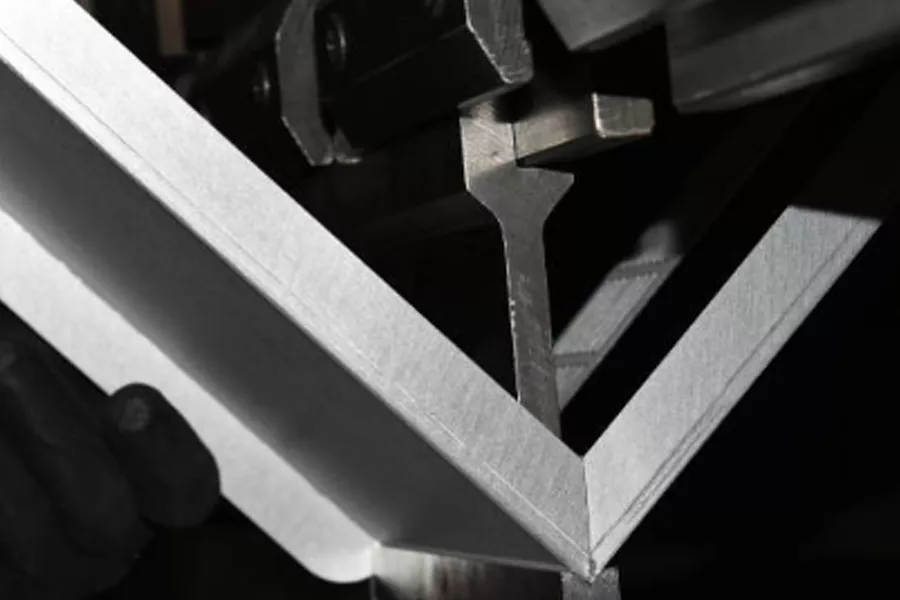
The core principle of bending is to apply mechanical pressure to metal plates using the upper and lower molds of a bending machine, causing the material to undergo plastic deformation and thus form components with specified angles and contours. The entire processing flow is coordinated and scheduled by the system, and the core process can be decomposed into three main steps.
First is parameter programming: Engineers input parameters such as sheet thickness, material, bending angle, and bending sequence into the system based on part drawings. The system automatically calculates the required pressure, bending compensation value, and die matching plan, avoiding precision deviations caused by material springback.
Next is positioning and clamping: The metal sheet is accurately fixed on the bending machine's worktable using the rear stopper mechanism and positioning pins, ensu ring that the reference position for each bend is completely consistent and guaranteeing the repeat accuracy of batch production.
The final step is bending and forming: The system drives the slide downward, bringing the upper and lower molds together to apply precise pressure to the sheet, completing the plastic deformation. During this process, the system monitors pressure and displacement in real time, automatically compensating for material springback errors, ultimately achieving an angular precision of ±0.5° and a dimensional precision of ±0.05mm.
Depending on processing requirements, bending can be categorized into modes such as free bending, bottoming bending, and roll bending. These modes are respectively adapted for processing parts of different thicknesses, materials, and complexity levels, fully demonstrating the flexibility and adaptability of the process.
The Core Advantages of Bending Technology in Precision Manufacturing
Ultra-high Repeatability and Stable Consistency: Bending relies on CNC control and servo drive systems to achieve a processing level with angular repeatability of ±0.3° and dimensional repeatability of ±0.03mm, which is far superior to traditional manual bending. This stability allows mass-produced parts to meet precision assembly requirements without secondary fitting, significantly reducing scrap rates and rework costs.
Flexible Production and Rapid Changeover Capability: By storing preset programs, bending machines can switch between processing different parts within minutes without the need to replace molds or fixtures. This flexible feature perfectly matches precision manufacturing orders for a variety of products in small batches, enabling quick response to market demand changes and shortening product delivery cycles.
High-efficiency energy saving and automation potential: Modern bending machines are equipped with energy-saving servo motors and intelligent pressure control systems, reducing energy consumption by more than 30% compared to traditional hydraulic bending machines. Combined with automatic loading, unloading, and robotic handling systems, they can achieve unmanned production cells, further enhancing production efficiency and safety in precision manufacturing.
Typical application scenarios of bending technology in precision manufacturing
New Energy Equipment Manufacturing: In new energy fields such as photovoltaics and energy storage, bending is widely used in the processing of parts like inverter casings, battery pack frames, and photovoltaic supports. These components have extremely high requirements for flatness and airtightness. The high precision of bending ensures that assembly gaps are controlled within 0.1mm, guaranteeing the long-term stable operation of the equipment.
Medical Device Industry: Metal components in medical devices often involve complex ergonomic structures, such as operating table frames, monitor casings, and implantable device bases. Bending enables the precise forming of medical-grade stainless steel and titanium alloy materials, avoiding stress concentration that could affect biocompatibility, while also meeting the cleanliness requirements for sterile production.
Electronic and Communication Equipment: Components of electronic devices such as 5G base stations, server cabinets, and precision instrument casings need to balance lightweight design with structural strength. Bending can process ultra-thin plates with thicknesses ranging from 0.5 to 3mm. Through precise bending, reinforcing ribs and heat dissipation structures are formed, which enhance component rigidity while reducing weight, adapting to the development trend of miniaturization and high-density integration in electronic equipment.
Aerospace field: Aerospace components have nearly extreme requirements for weight and precision. Bending can be used for forming and processing lightweight materials such as aluminum alloys and magnesium alloys, for example, cabin interior parts, satellite brackets, and sensor casings. Through finite element analysis and optimization of bending parameters, lightweight design and high-precision forming of components can be achieved, meeting the stringent standards of the aerospace industry.
Future Development Trends of Bending Technology
As precision manufacturing evolves towards intelligence and green practices, bending processes are also continuously iterating and upgrading.
Technologically, the integration of artificial intelligence and machine vision will enable automatic optimization of bending parameters and real-time defect detection. By predicting material springback and stress distribution through algorithms, this will further enhance processing accuracy and efficiency. Meanwhile, exploration of new processes such as ultra-fast laser-assisted bending and electromagnetic pulse bending will break through the thickness and shape limitations of traditional bending, expanding the forming boundaries of precision manufacturing.