
Precision Release: Wire EDM Technology Revolutionizes Modern Mechanical Machining
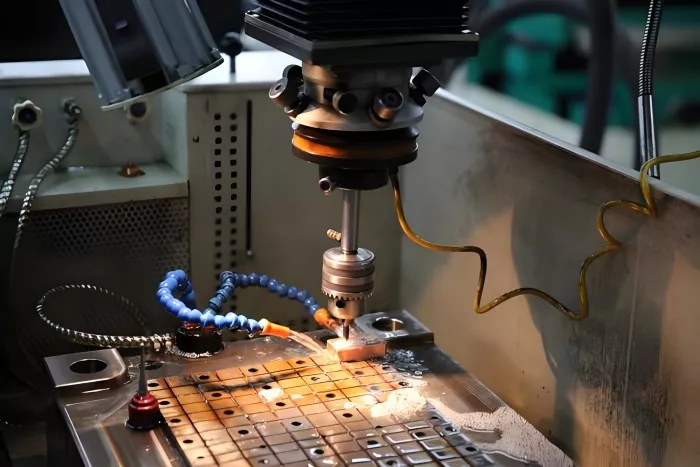
Electrical Discharge Machining (Wire EDM) is the cornerstone of precision manufacturing. This non-traditional process cuts conductive materials with ±0.002 millimeter-level precision using controlled electric spark erosion technology, excelling particularly at complex geometries, hardened alloys, and micro-features that traditional tools cannot machine. At its core is a thin wire cutting electrode (wire edm wire), typically made of brass or coated wire, which performs the cutting while dielectric fluid flushes away swarf and cools the workpiece. Unlike traditional mechanical machining, the zero-contact-force characteristic of Wire EDM completely eliminates the risk of deformation in thin-walled parts.
Fast Wire vs. Slow Wire: A Technical Deep Dive
Fast Wire:
Employs a molybdenum wire moving back and forth at high speed (8-12 meters per second). Offers significant cost-effectiveness, but vibration limits precision to ±0.02 millimeters and surface roughness to Ra 1.6-3.2μm. Widely used in general-purpose tooling and prototyping in China.
Slow Wire:
Utilizes disposable brass wire (<0.2 meters per second) in conjunction with deionized water and a constant tension system. Achieves precision of ±0.005 millimeters and surface finish of Ra <0.4μm through multiple passes. The preferred solution for aerospace and medical applications.
Hybrid Medium-Speed Systems:
Combines high-speed roughing with low-speed finishing to maintain near-slow-wire precision while enhancing efficiency—ideal for mold inserts and gear machining.
The Core Value of Wire EDM Electrode Wires
Wire EDM electrode wires (wire edm wire) require dedicated materials for specific applications:
Diameter Range: 0.10–0.30 millimeters (commonly 0.20–0.25 millimeters)
Tensile Strength: 900–1,180 Newtons per square millimeter to prevent breakage
Electrical Conductivity: 22–25% IACS to ensure efficient discharge
Advanced materials such as zinc diffusion coated wires can further reduce the breakage rate during precision cutting.
Wire Cut Fixtures: The Foundation of Precision Stability
Achieving strict 5-micron tolerance control relies on wire cut fixtures:
Material: Non-conductive composite material to prevent arcing
Clamping: Low-stress vise to avoid deformation from prolonged machining
Modularity: Enables quick tooling changes for batch processing of electrodes/medical components
Supports high-difficulty operations such as turbine blade taper cutting or machining workpieces up to 1000mm thick.