
CNC Precision Machining: 0.005 Millimeter Level Accuracy
In today's industrial manufacturing, which is constantly moving towards customization and high-endization, a key term is repeatedly mentioned—CNC precision machining.
Whether it's the turbine blades of aerospace engines, high-strength gears in automotive power systems, or micrometer-level aluminum structural components in consumer electronics, these parts that have extremely high requirements for precision, efficiency, and reliability are almost all inseparable from CNC precision machining.
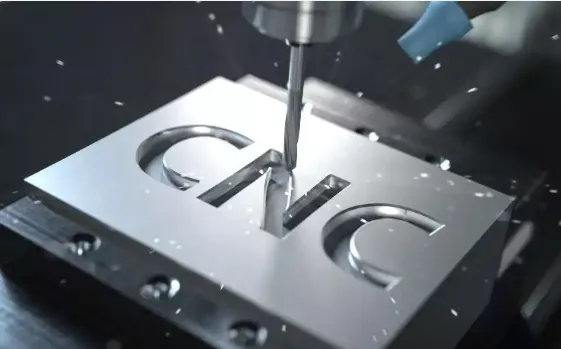
Compared to traditional manual or conventional CNC machining, CNC precision machining is a manufacturing method where tools are controlled by computer programs to cut and shape materials such as metal or plastic with micrometer-level precision. It has unique advantages including high precision, strong stability, the ability to process complex structures, and adaptability to various materials.
④
1. Why Choose CNC Precision Machining?
① Micron-level High Precision & High Repeatability
Tolerance accuracy can reach ±0.005mm (0.0002 inches)
Every component can achieve high consistency, meeting the requirements of high-reliability scenarios such as connection structures of aerospace vehicles
② Processing complex geometric structures
Multi-axis machining (3/4/5 axes or even 6/7 axes) can achieve internal cavities, deep grooves, inclined surfaces, and thin-walled structures that are difficult to complete with traditional processes
Typical cases: turbine blades, medical implants, drone body monolithic shells
③ Compatible with various industrial-grade materials
Metals: Aluminum, copper, steel, stainless steel, titanium alloy, nickel-based alloy, etc.
Engineering plastics: PEEK, PC, PTFE, Delrin, Ultem, etc.
Composite materials: carbon fiber, ceramic matrix composites, etc.
④ Fast delivery, suitable for sampling + mass production
Digital programming plus automated machining has significantly shortened the processing cycle
For example: 3-day delivery for electronic product prototyping, and batch production of automotive parts within 20 days
⑤ Automation and intelligence, reducing manual effort and error rate
Multi-machine coordination, automatic tool changing, and online inspection enable "unmanned" production
Intelligent recognition + adaptive adjustment of cutting parameters to improve product pass rate
2. Core Application Industry Cases
Aerospace
Materials: Titanium alloy (Ti-6Al-4V), Inconel superalloy;
Part cases: Engine blades, hydraulic flanges, flow guide casings
Process Characteristics: Requirements include high-temperature strength, corrosion resistance, and consistency, with CNC five-axis machining as the core method
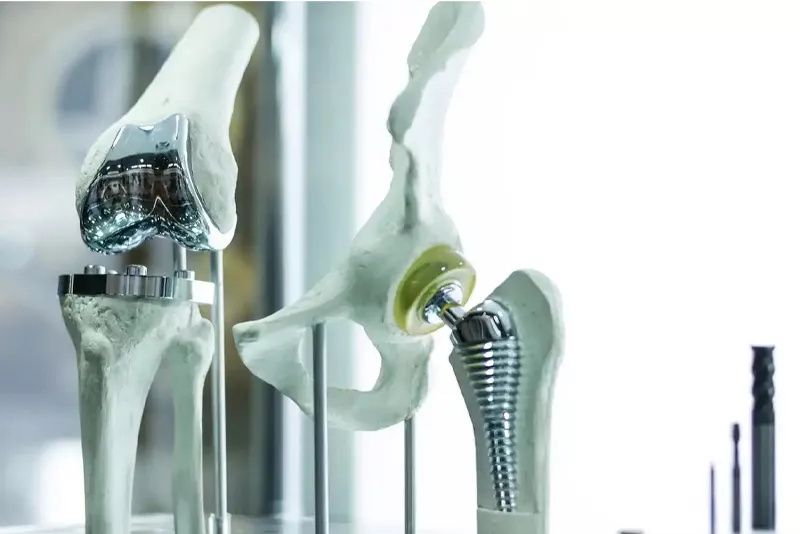
Medical devices
Materials: Pure titanium, medical stainless steel, PEEK.
Component cases: Hip joint ball head, dental implant abutment, spinal implant.
Processing Requirements: High surface finish (Ra < 0.2μm), burr-free, ultrasonic cleaning + sterile packaging
New energy vehicles
Materials: Aluminum 6061/7075, magnesium alloy, plastic engineering parts.
Part examples: Battery box base, control housing, electric drive system bracket
Process Trend: Lightweighting + Structural Integration, Combined Application of CNC and Laser Welding
Consumer Electronics
Materials: Aluminum alloy, anodized aluminum, engineering plastic.
Part examples: Mobile phone midframe, headphone bracket, laptop heat sink structural components.
Processing Requirements: High aesthetic details (precise chamfering, no tool marks), high assembly accuracy (±0.01mm)
3. Process Flow and Key Technologies of Precision Machining
① Computer-Aided Manufacturing (CAM) Programming
Generate G-code from CAD drawings and perform path simulation using CAM software
Automatic toolpath optimization, collision avoidance, and machining time estimation
②Cutting tools and fixtures
Common cutting tools: end mills, ball nose end mills, spiral drills, boring tools (hard alloy or coated materials)
Custom Fixtures: Multi-station Flexible Fixtures, Vacuum Fixtures, Magnetic Chucks
③ High-speed machining + Thermal management
High-speed spindle (12,000~30,000 RPM)
Precise cooling system (internal cooling + oil mist + air cooling) ensures stable cutting
Typical parameters: feed rate 0.1-0.3 mm/r, cutting depth 25 mm
④Surface Treatment & Post-Processing
Surface treatment: sandblasting, anodizing, electroplating, spraying, etc.
Post-inspection process: Coordinate Measuring Machine (CMM), Roughness Testing, 100% Full Inspection (for medical/aerospace use)