
CNC Machining Standards and Quality Control for Embodied Robot Components
Preface: Why Manufacturing Determines the Failure of Embodied Robots
Embodied robots (such as humanoid robots, quadruped robots, and mobile manipulation robots) are no longer confined to laboratory stages; they are gradually moving towards real-world application scenarios.
In this process, manufacturing quality is becoming a critical bottleneck for the large-scale deployment of robots.
Compared to AI algorithms and control systems, mechanical components directly determine a robot's structural strength, motion accuracy, durability, and consistency. For most robotics companies, the real bottleneck in transitioning from prototype to small-batch production to mass production often lies not in algorithms, but in the manufacturing and assembly stages. As a long-serving CNC precision machining vendor in the service robotics industry, Chang YuanFeng PRECISION has summarized the most practically valuable standards and goals for embodied robot components in terms of CNC machining and quality control.
Typical CNC Machined Components in Humanoid Robots
From a manufacturing perspective, robot components can be divided into the following four major categories:
1. Structural and Load-Bearing Components
Typical parts:
Joint housings
Motor housings
Reducer housings
Structural supports
Machining focus:
Rigidity, positional accuracy, assembly consistency
2. Motion and Transmission Components
Typical Parts:
Output Shaft
Joint Shaft
Coupling
Precision Sleeve
Processing Focus:
Concentricity, Surface Finish, Fatigue Life
3. Lightweight Structural Components
Typical Parts:
Aluminum Alloy Robotic Arm
Thin-Wall Bracket
Topology-Optimized Integrated Structural Components
Processing Focus:
Deformation Control, Weight Consistency
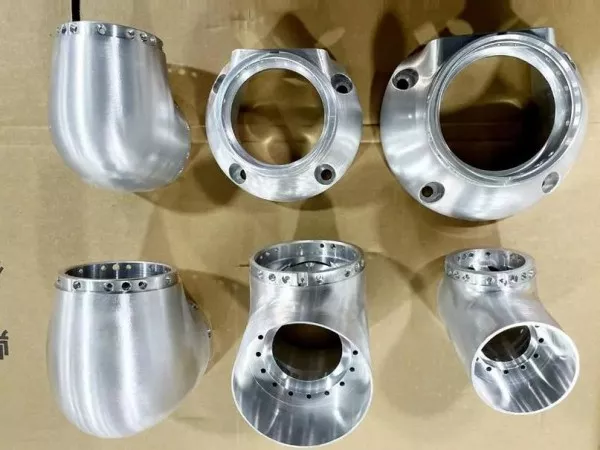
4. Multi-axis Complex Structural Components
Typical Parts:
Integrated Joint Modules
Multi-installation Surface Structural Components
Curved Surface Shells
Processing Focus:
Five-axis machining accuracy, completion degree of one-clamp processing
CNC Machining Process Specifications for Components of Embodied Robots
Structural Parts (Joint Housing / Motor Housing)
Typical CNC Process Flow:
Raw Material → Rough Machining → Stress Relief → Semi-Finish Machining → Finish Machining → Three-Coordinate Inspection (CMM)
Key Machining Control Points:
All assembly benchmarks are uniformly processed on the same reference.
Five-axis machining is used to reduce errors from multiple setups.
Critical hole positions are machined first, followed by the appearance surfaces.
Core Quality Objectives of CNC Manufacturing from the Perspective of Robot OEMs
Based on the cooperation experience of Yixin Precision with multiple robot enterprises, robot OEMs generally focus on the following five aspects:
High Assembly Success Rate
CNC accuracy directly determines assembly efficiency and debugging costs.
Batch Consistency Takes Priority Over Ultimate Precision
Robots are systems engineering, not single parts.
Early DFM (Manufacturability) Involvement
Processing and assembly should be considered during the design phase.
Scalable Process Routes
Processing solutions need to support future mass production.
Traceable Quality Data
Test data supports long-term reliability and iterative optimization.