
Bottleneck in Complex Medical Parts? Five-Axis Machining Unlocks Precision & Efficiency
For manufacturers of life science and medical device components, machining complex, high-precision parts is the cornerstone of daily production. Consider, for instance, the free-form surfaces of surgical instruments or the micron-tolerance interfaces in lab analyzers. The integrity of these parts is paramount, directly governing device performance and patient safety, with dimensional accuracy often measured in microns. Market demand is rising steadily, making mastery of such parts a key competitive differentiator. Yet, conventional 3-axis or 3+2-axis machining often presents a dilemma that undermines this goal: multiple fixturing introduces error stack-up, limited tool orientation restricts access to complex contours, and protracted processes delay deliveries. Why does machining complexity consistently create bottlenecks? Five-axis simultaneous machining centers offer the pivotal solution to transcend these limitations.
Pain Points of Traditional Machining: Why Is It Difficult to Break Through Bottlenecks in Complex Part Machining?
In the machining of medical device components, traditional three-axis machining requires multiple tooling changes and workpiece angle adjustments. Each clamping introduces tiny errors, which can accumulate and lead to products failing to meet precision requirements. For example, machining a curved part of a surgical instrument with three-axis machining requires 5-6 processes, which is not only time-consuming but also prone to dimensional deviations. Additionally, when processing irregular curved surfaces with traditional machining, the cutting tool cannot approach from the optimal angle, resulting in excessive cutting force that accelerates tool wear. This increases costs while affecting surface finish quality. These issues directly restrict the improvement of quality and production efficiency of life science components.
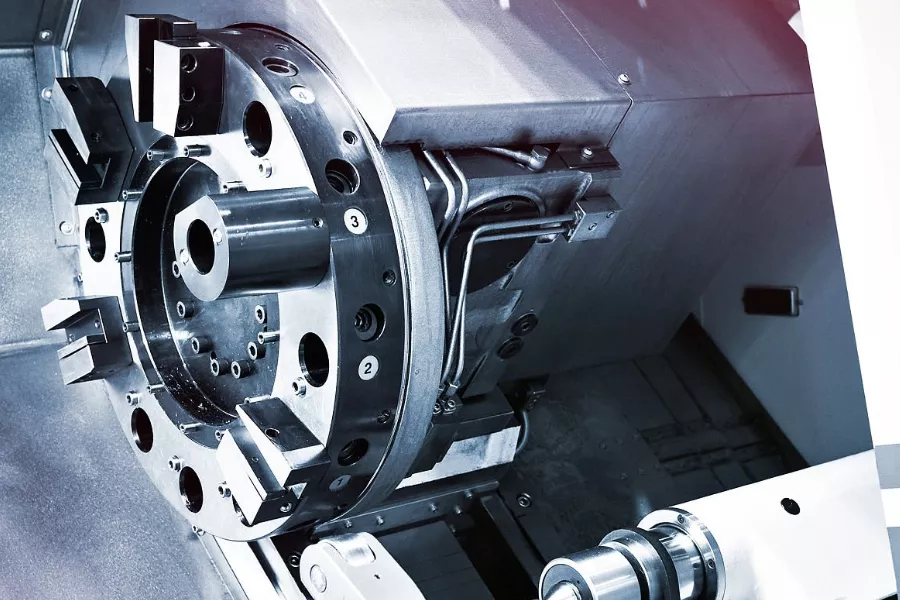
The core distinction between five-axis simultaneous machining and conventional methods lies in axis control. Traditional 3-axis machines operate only the X, Y, and Z linear axes, while 3+2-axis machining involves fixed-angle positioning that requires pre-set orientations. In contrast, five-axis machining integrates two additional rotary axes, enabling real-time adjustment of the workpiece or tool angle. This allows for continuous machining of complex, contoured surfaces in a single setup. The direct benefits are transformative: it drastically reduces—or often eliminates—multiple setups required in traditional machining, and optimizes tool paths for higher cutting efficiency and significantly reduced tool wear, overcoming the inefficiencies inherent in conventional path planning.
Five-axis machining centers achieve high-precision surface machining by simultaneously coordinating the motion of five axes (three linear + two rotary), allowing the cutting tool to approach the workpiece from virtually any direction. During operation, the CNC system dynamically calculates the optimal tool position and orientation in real-time based on the 3D CAD model, ensuring the cutter maintains tangential contact with the surface. This continuous, multi-axis interpolation enables the creation of complex geometries that are impossible with traditional methods. Coupled with high-precision servo drives and advanced CNC systems, these machines deliver positioning accuracy within micron-level tolerances, fully meeting the stringent requirements of medical device components.
Adopting five-axis simultaneous machining delivers comprehensive advantages across efficiency and cost. First, minimizing setups reduces human error and enhances part consistency and stability—critical for medical device applications. Second, optimized tool paths shorten cycle times, enabling faster response to market demands. Third, tool wear can be reduced by up to 30%, extending tool life and lowering consumable costs. Furthermore, high automation reduces manual intervention, alleviating labor dependency. Built with premium core components for durability and low maintenance, our solutions are backed by strong R&D capabilities tailored to the unique needs of the life sciences sector, having already provided reliable, proven solutions for numerous medical device manufacturers.
Market Trends in Five-Axis Machining:
The Inevitable Choice for Future Manufacturing Driven by the rapid advancement of the medical device and life science industries, demand for high-precision complex parts continues to grow. Industry reports indicate that the global market for five-axis simultaneous machining equipment is expected to expand at an annual rate of 12% over the next five years, with the medical device sector leading at 15%. This trend reflects the unique advantages of five-axis machining in addressing the limitations of conventional processes, as well as its proven impact on enhancing product quality and production efficiency. For manufacturers of life science components, adopting five-axis technology has become an essential step to maintaining competitiveness.
Embrace Five-Axis Machining:
Step into a New Era of Precision Manufacturing Five-axis simultaneous machining centers, characterized by high precision, efficiency, and flexibility, offer an ideal solution to the challenges of manufacturing complex parts. For companies in the life science and medical device industries, implementing this technology not only improves product quality but also reduces costs and strengthens market competitiveness. In today’s business environment, where customer expectations for precision and delivery times continue to rise, traditional machining methods often fall short. By dynamically adjusting tool angles and enabling single-setup machining of intricate surfaces, five-axis machining fundamentally resolves the shortcomings of conventional processes, opening the door to a new stage of precision manufacturing.