
A Brief Analysis of the Development Direction and Importance of Five-Axis Machining Centers
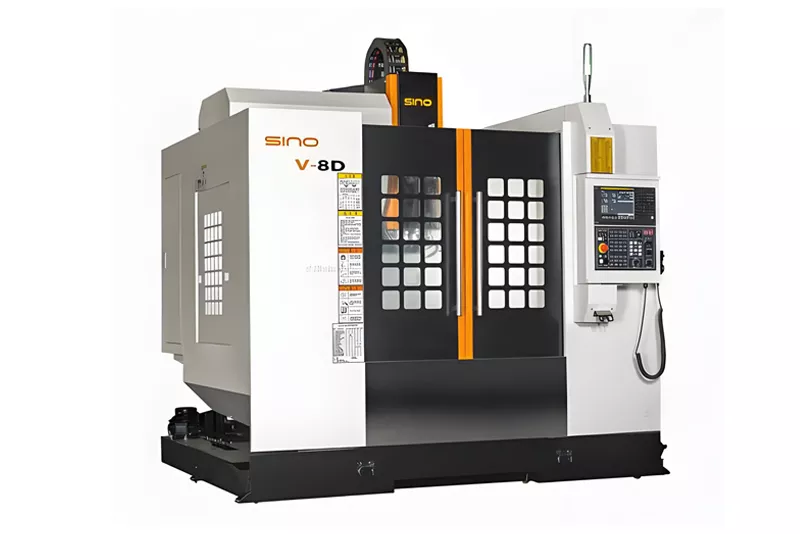
The five-axis machining center is specialized equipment designed for processing non-metallic and non-ferrous metal materials. It enables high-precision machining of complex spatial surfaces and allows for the multi-faceted profiling of workpieces in a single setup. Whether in military or private enterprises, the adoption of five-axis equipment has simplified processing workflows, reduced complexity, and lowered production costs. Currently, the five-axis machining center has become the development direction of high-end machining centers.
A five-axis machining center consists of five axes: A-axis, C-axis, and the three linear axes X, Y, and Z. When the A-axis and C-axis are synchronized with the three linear axes, complex spatial surfaces can be machined. This allows the workpiece to be subdivided at any angle, enabling the processing of inclined surfaces, inclined holes, and other complex features, thereby facilitating the machining of intricate workpieces. The application of five-axis machining centers turns the impossible into reality. By integrating functions such as milling, engraving, cutting, drilling, material separation, and grooving into a single system, it simplifies the machining of various complex components. This not only meets production requirements but also reduces manufacturing costs for enterprises, creating significant business opportunities and substantial benefits.
China's research and application of CNC machine tools started relatively late, resulting in a significant technological gap compared to developed countries. With the rapid development of key domestic industries such as aerospace, automotive, military, and power equipment manufacturing, there is an urgent need to upgrade manufacturing equipment to enhance the country's overall national strength. As the demand for machining centers increases domestically, rigorous analysis and calculation of their components have become essential in the design process. The quality of support structures like the machine bed and other critical parts directly impacts the stability and machining accuracy of these centers.
As an important equipment in the machinery manufacturing industry, it has made great progress in terms of variety, performance and functions in recent years. New five-axis machining centers can be used for processing parts in aviation and aerospace; there are high-performance machining centers specifically for mold processing, which integrate three-dimensional CAD/CAM for ultra-precision machining of complex mold surfaces; there are high-speed machining centers suitable for mass production of parts in the automotive and motorcycle industries, with high production efficiency and flexibility. The future development of five-axis machining centers will be increasingly rapid, and their prospects will be increasingly bright.