
Universal turning, complete machining of six faces, and process integration
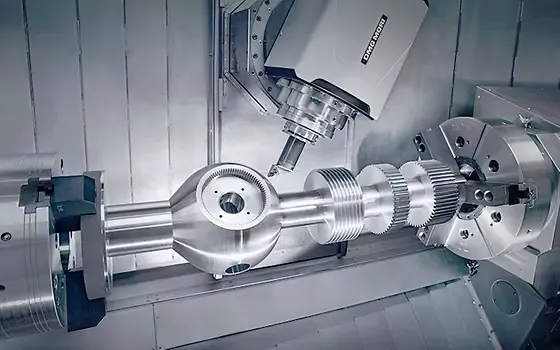
To date, turning remains the most effective technique for machining rotationally symmetric components. The combination of cutting speeds of several thousand revolutions per minute with long-lasting precision tools ensures maximum efficiency and extremely accurate production. Continuous further development has made lathes more productive. Turrets or linear tool carriers for holding multiple tools, tool drives, Y-axes for eccentric machining, and counter spindles are now standard features of modern turning centers. When necessary, a tailstock can support the machining of long workpieces. This equipment can produce complex turned parts within a single working area, thus eliminating the need for additional milling machines in many cases.
The integration of milling represents the beginning of a development phase that has continued to this day—encompassing complete six-sided machining on turn-mill centers. The powerful turn-mill spindle can rotate around the B-axis, elevating five-axis simultaneous machining to the level of modern CNC milling machines.
The machine tool flips the workpiece to the back using a sub-spindle to unload the finished part, taking process integration a step further. With the help of innovative technology cycles (such as those offered by DMG MORI), it is also possible to produce gears or perform grinding operations. In-process measurement completes the integration of additional process steps, enabling full-process tolerance inspection and minimizing the workload required for final quality control.