
The Evolution of CNC Machining Landscape: Key Trends Shaping 2025 and Beyond
Driven by continuous innovation and shifting global demand, the CNC machining industry is at a critical juncture. As 2025 approaches, manufacturers must lead the trend of redefining precision, efficiency, and sustainability. For businesses seeking advanced solutions, understanding these transformations is crucial. This article will analyze the potential for transformation in CNC machining capabilities in 2025.
1. Supernatural and Lighting Production
Factories are embracing an increasing number of fully automated workflow AI numerical control systems, which enable unmanned operation at night ('lights-out manufacturing'). This will shorten machining time by 40-60% while ensuring round-the-clock production. Visual systems and adaptive machining can compensate for tool wear in real time, thereby eliminating manual intervention in daily tasks. Logistics integration—such as automatic pallet code changers and robotic partial machining—further simplifies the process. First-tier suppliers are expected to take advantage of this to achieve fast, error-free turnover.
2. Accuracy Driven by Artificial Intelligence and Predictive Analytics
Beyond automation, generative artificial intelligence innovates in manufacturing. The algorithm can optimize tool paths to minimize material waste, predict machine failures (reducing downtime by 30%), and dynamically adjust feed rates based on sensor data. Cloud-based analytics convert historical job data into actionable insights, balancing cost, speed, and quality. For mission-critical sectors such as aerospace and medical implants, the defect prevention capabilities of artificial intelligence are not yet commercially acceptable.
3. Advantages of 5-Axis Machining in Complex Geometries
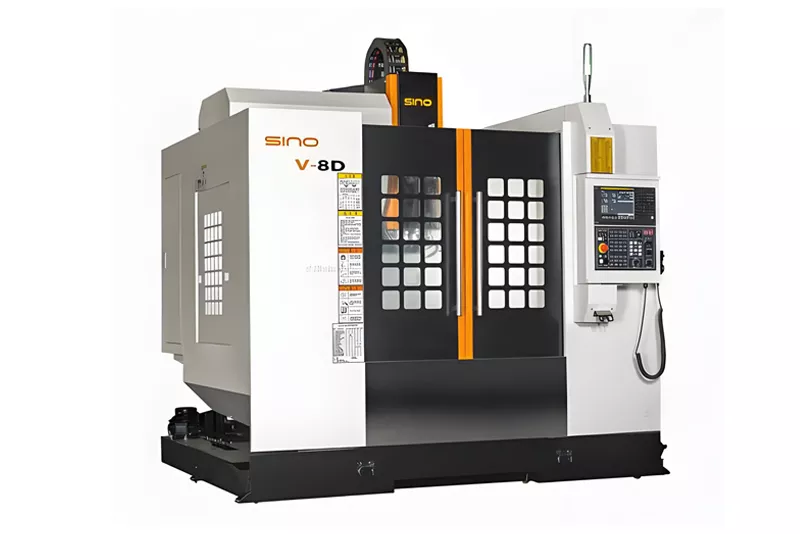
The demand for complex, one-time setup machining is surging. Five-axis CNC systems are not only 'superior to three-axis' but also the foundation for machining complex contours, deep cavities, and curved surfaces in applications such as turbines, prosthetics, or AR/VR hardware. Continuing with turbine milling (5-axis simultaneous high-speed movement) achieves mirror finish machining without the need for auxiliary polishing. Our 5-axis vertical milling centers consistently achieve a tolerance of ±0.01 millimeters on aerospace alloys, titanium, and plastics.
4. Sustainable processing is at the center
Regulatory pressures and ESG goals are driving 'green processing' into the mainstream:
Material Efficiency: AI nesting can reduce waste by 15-30%.
• Energy Recovery: Regenerative drives convert braking energy into reusable power.
• Coolant Innovation: Biodegradable coolants and Minimum Quantity Lubrication (MQL) can reduce chemical usage by 80%.
Leading manufacturers now audit the carbon footprint of each part—prioritizing solar facilities and recycled material programs as key indicators.
5. Digital Twin and Virtual Debugging
There is no need for expensive trial and error anymore. Digital twins can simulate the machining process in real time, verify G-code, predict collisions,
and forecast thermal drift errors. When used with AR-assisted maintenance, technicians can view repair manuals through smart glasses, reducing unplanned downtime.
It is expected that digital thread integration (from CAD to QA) will become an industry standard by 2025.
6. Customization on Demand, Micro-batch Production
Mass customization is gradually declining. The flexibility of CNC supports micro-batches (1-100 units) for prototyping, R&D, and niche industrial applications.
Cloud platforms allow customers to submit designs for instant review and real-time tracking of the production process. The one-stop model—with roofs that include machining,
surface treatment, and heat treatment—is less suited to this agile, customer-oriented future.
7. Through localized supply chain flexibility
After the pandemic, manufacturers are rejecting fragile global supply chains. Regional production 'hubs' (such as [Regional Name]) minimize delays through on-demand digital inventory.
Tracking distributed manufacturing via encrypted blockchain—enabling full-process auditing from factories to materials—enhances transparency.
Conclusion: Prepare for a smarter, more adaptive future
The development trajectory of the CNC industry in 2025 is clear: achieving efficiency through artificial intelligence, sustainability through empowerment, and flexibility through automation.
For engineers and procurement teams, the key to choosing a partner lies not in the machines themselves, but in whether they possess the expertise to coordinate these trends.
By integrating five-axis precision, eco-conscious practices, and end-to-end solutions, complex designs are transformed into perfect realities.
As tolerance windows narrow and materials science advances, only forward-thinking manufacturers can thrive. Embrace the future—prioritizing R&D, agility, and an unwavering pursuit of quality,
along with partnerships that surpass competitors.