
The Concept and Application of Machining Centers
A machining center is a numerical control machine tool equipped with a tool magazine and capable of automatically changing tools to perform multi-process machining on workpieces.
After a single workpiece setup, the digital control system can control the machine tool to automatically select and replace tools according to different processes, automatically change the spindle speed, feed rate, relative motion trajectory of the tool with respect to the workpiece, and other auxiliary functions, thereby sequentially completing multi-process machining on several surfaces of the workpiece.
Machining centers, due to the concentration of processes and automatic tool changing, reduce the time for workpiece clamping, measurement, and machine tool adjustment, allowing cutting time to account for about 80% of machine operating time (compared to only 15-20% for conventional machine tools). They also reduce the time for workpiece turnover, transportation, and storage between processes, shortening production cycles and yielding significant economic benefits. Machining centers are suitable for medium and small batch production of parts with relatively complex shapes, high precision requirements, and frequent product changes.
The first machining center was successfully developed by the American company Kearney & Trecker in 1958. It added an automatic tool-changing device to the basis of a CNC horizontal boring and milling machine, thereby enabling the concentration of multiple processes such as milling, drilling, boring, reaming, and tapping after a single workpiece clamping.
Since the 1970s, machining centers have developed rapidly, and swappable spindle box machining centers have emerged. These centers are equipped with multiple multi-axis spindle boxes containing tools that can be automatically replaced, enabling simultaneous multi-hole machining of workpieces.
This form of centralized multi-process machining has also been extended to other types of CNC machine tools, such as turning centers. A turning center is a CNC lathe equippe d with multiple automatic tool-changing devices, capable of controlling three or more coordinates. In addition to turning, the spindle can stop or index, allowing the rotating tool to perform milling, drilling, reaming, and tapping operations. It is suitable for machining complex rotating parts.
Milling centers are divided into two categories based on the arrangement of their spindles: vertical and horizontal. Horizontal milling centers typically have indexing tables or CNC rotary tables, which allow for machining of various sides of a workpiece; they can also perform combined movements across multiple axes to machine complex spatial curved surfaces. Vertical milling centers generally do not have rotary tables and are used primarily for top surface machining. In addition, there are composite milling centers with both vertical and horizontal spindles, as well as vertical-horizontal adjustable milling centers whose spindles can be adjusted to either horizontal or vertical orientation. These types of milling centers are capable of machining five faces of a workpiece.
The automatic tool changing device of a machining center consists of a tool magazine for storing tools and a tool changing mechanism. There are many types of tool magazines, with disc-type and chain-type being the most common. Chain-type tool magazines have a larger capacity for storing tools.
The tool changing mechanism exchanges tools between the machine tool spindle and the tool magazine. Common types include robotic arms. There are also armless tool changing devices that directly exchange tools between the spindle and the tool magazine without a robotic arm.
To further reduce non-cutting time, some machining centers are equipped with two automatic workpiece exchange pallets. One pallet holds the workpiece being machined on the worktable, while the other is used for loading and unloading workpieces outside the worktable. After the machine tool completes the machining cycle, the pallets are automatically exchanged, overlapping the time for workpiece loading/unloading with the cutting machining time. Machining centers are typically classified by the relative position of the spindle and the worktable, and are divided into horizontal, vertical, and universal machining centers.
(1) Horizontal Machining Center: Refers to a machining center where the spindle axis is arranged parallel to the worktable. It is mainly suitable for processing box-type components.
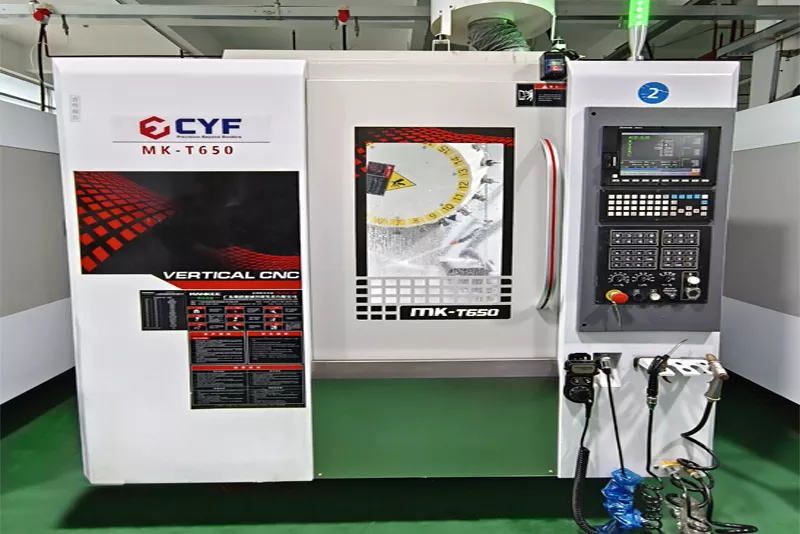
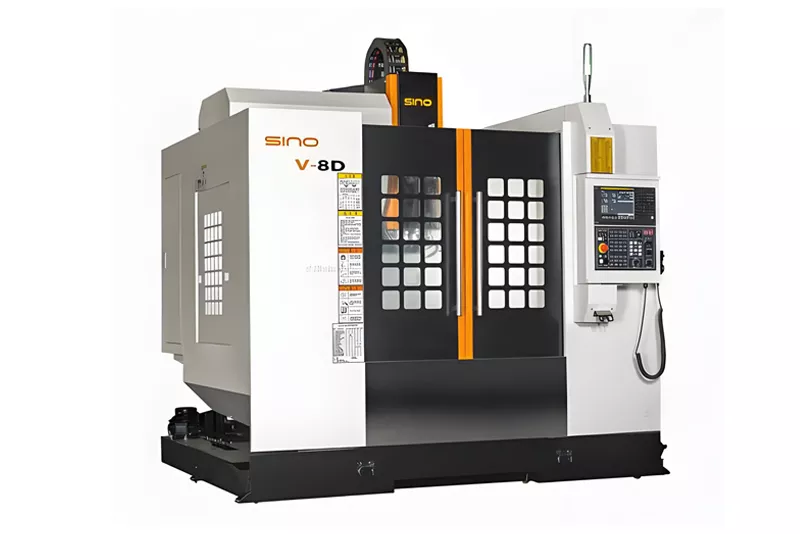
(2) Vertical Machining Center: Refers to a machining center where the spindle axis is arranged perpendicular to the worktable. It is mainly suitable for processing plate-type, disc-type, mold, and small housing-type complex parts.
(3) Universal Machining Center (also known as Multi-axis Simultaneous Machining Center): Refers to a machining center that can complete the processing of complex spatial curved surfaces by controlling the linked variation of the angle between the machining spindle axis and the worktable rotation axis. It is suitable for processing workpieces with complex spatial curved surfaces such as impeller rotors, molds, and cutting tools.