
High-end Manufacturing Upgrade: Precision Electrical Discharge Machining Solves Processing Challenges of High-Hardness Parts
In the field of precision machining, not all parts can be completed using traditional cutting processes. When dealing with hard and brittle materials, parts with a hardness above HRC60, or complex irregular structures such as mold cavities and irregular holes, the drawbacks of traditional cutting tools—such as easy wear and insufficient machining accuracy—are fully exposed. As a core technology of special precision manufacturing, precision electrical machining processes, leveraging the unique advantage of 'non-traditional cutting', do not require direct contact between the tool and the workpiece. Instead, they remove material through electric, thermal, and chemical energy, becoming a core supporting technology for high-end fields such as mold manufacturing and aerospace.
Unlike traditional precision manufacturing processes such as turning and milling, which rely on tool cutting forces to remove material, the core logic of precision manufacturing electrical machining technology is 'energy erosion'—using controllable non-mechanical energies such as electricity, heat, and chemistry to cause melting, vaporization, or electrochemical dissolution of the workpiece surface material, thereby achieving part forming. The greatest advantage of this machining method is that it eliminates direct contact between the tool and the workpiece, so there is no need to consider whether the tool hardness matches the workpiece. As a result, it can easily handle high-hardness, hard-brittle, and complex irregular parts that traditional cutting cannot process. Especially in the field of mold processing, precision manufacturing electrical machining technology has almost become an indispensable core process, capable of ensuring machining accuracy while improving the machining efficiency of complex surfaces.
Core Characteristics of Precision Manufacturing Electrical Discharge Machining (EDM) Technology: Why It Can Meet High-Difficulty Machining Demands?
As a representative technology of special precision machining, the core characteristics of precision manufacturing EDM technology are 'non-contact, low cutting force, high precision, and broad adaptability'. These are the key factors that distinguish it from traditional cutting processes. Specifically, they can be summarized into three points:
• No direct contact between tool and workpiece: This avoids the squeezing and deformation of the workpiece caused by cutting forces, making it particularly suitable for machining thin-walled, precision, and complex irregular parts, with machining accuracy reaching the micrometer level;
• Unrestricted by workpiece hardness: Whether it is high-hardness alloys above HRC60 or hard-brittle materials such as ceramics and hard metals, efficient machining can be achieved, solving the pain points of rapid wear and difficulty in machining with traditional cutting tools;
• Strong machining flexibility: Complex structures such as mold cavities, deep grooves, and irregular holes can be machined without complex tools, significantly reducing the machining cost and cycle for complex parts.
Currently, precision manufacturing EDM technology has been widely applied in high-end manufacturing fields such as mold manufacturing, aerospace, medical equipment, and automotive parts. Among these, mold machining is its most core application scenario—whether it is the cavity and core of plastic molds or the punch and die of stamping molds, all rely on the precise support of precision manufacturing EDM technology, making it a key technology for 'improving quality and efficiency' in mold machining.
Detailed Explanation of the Three Main EDM Processes in Precision Manufacturing: Principles, Characteristics, and Application Scenarios
Precision manufacturing electrical discharge machining processes can be categorized into three main types based on different energy forms: precision manufacturing die-sinking EDM, precision manufacturing wire EDM, and precision manufacturing electrochemical machining. Each of these three processes has its own focus and is suitable for different processing requirements and scenarios:
Precision Manufacturing EDM (Electrical Discharge Machining): The 'Sharp Tool' for Complex Cavity Processing
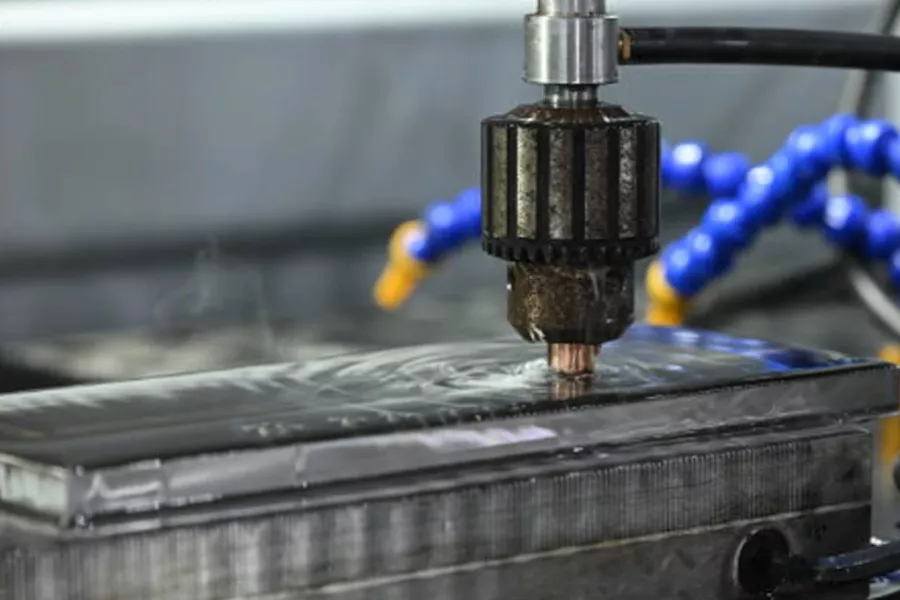
Precision manufacturing EDM (Electrical Discharge Machining), also known as die-sinking EDM, is a machining process whose core principle involves generating high-frequency electric sparks between an electrode and the workpiece. These sparks produce instantaneous high temperatures (exceeding 10,000°C), causing the workpiece's surface material to melt and vaporize, thereby achieving material removal and part formation. During processing, a minute discharge gap (typically 0.01-0.1mm) is maintained between the electrode and the workpiece, eliminating the need for direct contact. The energy generated by the discharge completes the machining process.
The greatest advantage of EDM (Electrical Discharge Machining) technology is its ability to process complex contours that traditional cutting tools cannot reach, making it particularly suitable for machining structures such as mold cavities, irregular holes, and deep grooves. For example, complex cavities of plastic molds, irregular cores of die-casting molds, as well as deep grooves, blind holes, and irregular holes on various parts can all be precisely machined using EDM technology. In addition, EDM offers high machining accuracy and good surface roughness. After machining, the part surfaces do not require additional polishing and can directly meet the assembly requirements of precision parts. It is widely used in mold manufacturing fields such as plastic molds, die-casting molds, and powder metallurgy molds. It is also applicable for machining complex structures of high-hardness alloy parts.
Precision Manufacturing Wire Electrical Discharge Machining (WEDM): The 'Precision Tool' for Irregular Contour Machining
Wire Electrical Discharge Machining (WEDM), used in precision manufacturing, operates on a principle similar to EDM, relying on electric spark erosion to remove material. However, unlike EDM, WEDM uses a continuously moving metal wire (typically molybdenum or copper wire) as the electrode. By discharging between the metal wire and the workpiece, it achieves the cutting and shaping of part contours. Depending on the speed of the metal wire movement, WEDM is divided into two types: fast wire and slow wire. There are significant differences between these two types in terms of machining accuracy and surface quality.
Fast wire EDM (WEDM) features a relatively high metal wire moving speed (typically 8-10 m/s), offering high processing efficiency and lower cost. It is suitable for machining irregular parts with medium to low precision and is widely used in general molds, hardware parts, and other fields. Slow wire EDM (WEDM), on the other hand, has a slower metal wire moving speed (typically 0.1-0.5 m/s), providing extremely high machining accuracy up to IT6 grade and surface roughness Ra below 0.2 μm. It is ideal for machining parts requiring high precision and high surface quality, such as convex and concave dies of precision molds, irregular contour parts, and precision irregular parts in the aerospace field.
Compared to EDM (Electrical Discharge Machining) technology, WEDM (Wire Electrical Discharge Machining) technology is more adept at machining two-dimensional irregular contours. It offers strong processing flexibility, eliminating the need to manufacture complex electrodes. By programming, it can achieve rapid machining of various irregular contours, significantly improving the processing efficiency and accuracy of complex irregular parts. It is an indispensable important technology in mold processing and precision part manufacturing.
Precision Manufacturing Electrochemical Machining (ECM): The 'Giant' for Processing Large, High-Hardness Parts
Electrochemical Machining (ECM), a precision manufacturing process distinct from the first two electrical discharge machining techniques, operates on the core principle of material removal through electrolytic reactions. In ECM, the workpiece serves as the anode and the tool electrode as the cathode, both immersed in an electrolyte solution. By applying a direct current voltage, the workpiece surface undergoes electrochemical dissolution, enabling the formation of the part. Relying on chemical energy for machining, ECM offers advantages such as no cutting forces, no thermal deformation, excellent surface finish, and high processing efficiency. These characteristics make it particularly suitable for batch production of large, high-hardness, and complex parts.
The greatest advantage of ECM technology is that it is not restricted by workpiece hardness, allowing the machining of various high-hardness alloys and heat-resistant alloys. It is particularly suitable for processing large and complex parts, such as aero-engine blades, gun barrel rifling, and cavities of large molds. As a core component in the aerospace field, aero-engine blades are made of high-hardness heat-resistant alloys with complex structures and high precision requirements, making them extremely difficult to machine using traditional cutting processes. However, ECM technology enables efficient and precise machining of blades, ensuring both dimensional accuracy and surface quality while significantly improving machining efficiency. For the machining of gun barrel rifling, high precision and consistency are required, and ECM technology can achieve batch-precision machining of rifling, meeting the stringent requirements of weapon equipment.
Precision Manufacturing Electrical Machining Technology, Empowering the Upgrade of High-End Manufacturing
As a core technology in special precision machining, precision manufacturing electrical machining technology, with its unique advantages of 'non-contact, high precision, and broad adaptability', has broken through the limitations of traditional cutting processes. It unlocks the challenges of machining high-hardness, hard-brittle, and complex irregular parts, becoming a 'core support' in high-end manufacturing fields such as mold manufacturing and aerospace.
Precision manufacturing EDM (Electrical Discharge Machining) excels in processing complex cavities. Precision manufacturing WEDM (Wire Electrical Discharge Machining) specializes in precise machining of irregular contours. Precision manufacturing ECM (Electrochemical Machining) is suitable for processing large, high-hardness parts. These three processes each have their own roles and complement each other, meeting the machining needs of different fields. As the high-end manufacturing industry continues to develop, the requirements for part machining accuracy, efficiency, and complexity are constantly increasing. Precision manufacturing electrical discharge machining technologies will also continuously upgrade and optimize, playing an even more important role in the high-end manufacturing sector and helping China's manufacturing industry transform towards 'precision, high-end, and intelligence'.