
DMG MORI Case Study: CNC Machining Production in the Automotive Electrification Transition
The electrification of automobiles is reshaping the demand for CNC machine tools in the automotive industry. Although internal combustion engines will not disappear entirely in the near future, the focus of production is shifting toward electric motors, power battery housings, and power electronic devices. The challenge lies in the fact that CNC machine tool manufacturers must simultaneously address parallel challenges while investing in new technologies. Those who focus on flexible production systems, process integration, and digital transparency will stand out in meeting the challenges brought by these transformations.
Understanding the new workpiece
This transformation is characterized by a distinct feature: the service scope of machine tool manufacturers and suppliers must become broader. Traditional components, such as crankshafts, cylinder heads, and camshafts, have been replaced by entirely different parts, leading to a complete shift in demand for machine tools. For instance, motor rotors and stators require micron-level high precision, as even slight deviations can significantly affect motor efficiency. Power battery housings also demand the precise and efficient machining of large-area lightweight structural components. These new applications fully demonstrate that purely mechanical processing will increasingly struggle to meet future demands. The variety of workpieces and materials is becoming more diverse, with aluminum and composite materials gaining growing importance. This calls for more flexible and comprehensive processing technologies, ranging from the proper design and selection of cutting tools and machining parameters to actual processing and finishing.
Grasp the technical requirements
The electrification of automobiles has significantly altered the scope of workpieces for automakers and their suppliers, thereby transforming production demands. Stricter precision requirements, demanding micron-level high accuracy, have emerged. In contrast, traditional drive systems typically required precision in the range of 0.01 to 0.05 mm. This shift means that precision machine tools and temperature-stable production environments have become increasingly critical. In-process measurement is now more frequently conducted within the machining area to ensure consistent quality, thereby reducing scrap rates and minimizing the need for subsequent quality control. Additionally, continuous measurement has become a vital tool for documenting workpiece quality. This is because manufacturers in the automotive industry now require greater digital process transparency than ever before.
5-axis machining with process integration
Five-axis machining is gradually becoming a standard technology. Five-axis technology enables the machining of complex geometries in a single setup, avoiding the quality risks associated with multiple setups. At the same time, five-axis technology serves as the foundation for process integration, allowing for not only the incorporation of measurement steps. Modern machining centers can perform turning, milling, drilling, gear machining, and grinding operations in a single setup—eliminating the need for dedicated standalone machines and achieving higher production capacity. Comprehensive automation solutions are increasingly becoming a key and indispensable component of economical production, integrating additional processes such as workpiece cleaning.
Flexibility is the key to survival
Compared to components of traditional drive systems, parts for electric vehicles typically require tighter tolerances, with the precision of housing components being particularly critical. The diversity of workpiece types is partly due to the variety of electric vehicle platforms, performance levels, and battery designs.
On the other hand, electric vehicle technology is advancing rapidly, with shorter product lifecycles. This demands greater flexibility in production from CNC manufacturers. Modular machine tool designs can quickly adapt to new requirements, while automation solutions offer enhanced versatility and adaptability. Automating the production of many different workpieces, including small-batch production, must be both rapid and straightforward. Agility is essential for maintaining production efficiency, especially during the profound transition to automotive electrification.
Sustainability is a competitive advantage.
The purpose of automotive electrification is climate protection, primarily through the use of electric vehicles. However, manufacturers must consider the entire supply chain. Suppliers need to implement verifiable, sustainable production processes and carbon emissions management. In the field of CNC machining, modern, energy-efficient machine tools are key to designing comprehensive production solutions. Reducing energy consumption and benefiting from the intelligent recycling of cooling lubricants are crucial. High-precision, high-quality machining also minimizes material usage, enables efficient chip recycling, and conserves resources.
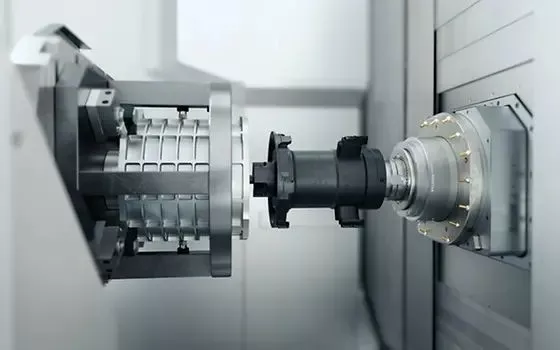
DMG MORI horizontal machining centers, such as the DMC 65 H monoBLOCK, can meet the high-precision requirements for electric vehicle components.
The stringent demands for electric vehicle parts have expanded the service scope of enterprises. PWS Presswerk Struthütten, located in Neunkirchen, Germany, serves industries such as automotive by providing research and development as well as mass production services for its clients. In 2022, PWS received an order to machine the bottom plate components for the power battery of a hybrid vehicle, thereby entering the machining business. They selected four DMG MORI NHX 8000 horizontal machining centers, which enable highly automated and precise machining of these critical components. These machines are interconnected using the MATRIS modular robotic system for workpiece and pallet handling. The automation scope spans the entire production process, from raw materials to finished products, including machining, cleaning, quality inspection, deburring, and final marking of unique serial numbers on the workpieces. This flexible production solution is designed to allow cost-effective large-scale production of other workpieces in the future.
Authentication is key
The workpiece characteristics of the power battery box are large-area lightweight structural components.
Despite significant progress in manufacturing technology, the production of electric vehicle parts remains highly challenging and requires professional personnel with comprehensive skills. They need to be proficient in mastering mechanical principles, material knowledge, and digital capabilities, and integrate them seamlessly. The training and continuing education of such professional talents have become an urgent need for CNC enterprises, for example, receiving training in 5-axis programming or process digitization. To maintain success, CNC manufacturing enterprises must systematically invest in people: participating in training provided by machine tool manufacturers, learning through online course platforms, and rotating among different production positions. This is not only to master the necessary skills but also to enhance the attractiveness of employers to employees.
Looking forward to the future
The transformation of electric vehicles is full of challenges and opportunities. If numerical control manufacturing enterprises invest in technology, training, and processes at an early stage, they can maintain a long-term competitive advantage in the growing market. DMG MORI provides these enterprises with innovative and comprehensive production solutions to support them in continuously meeting higher future demands. Highly integrated processes enable efficient machining strategies, automated handling supports flexible mass production, and digitization throughout the entire production process forms the basis for sustainable and long-term production.