
CNC machining technology continues to empower the construction of a modern industrial system
The second item of the outline of the 2025 National Economic and Social Development Plan explicitly proposes to develop new quality productive forces in a way suited to local conditions and accelerate the building of a modern industrial system. Specific contents include promoting the large-scale application of industrial internet, implementing digital transformation of manufacturing, continuously fostering and expanding emerging industries, and deepening pilot programs for the integrated development of advanced manufacturing and modern services.
Computer Numerical Control (CNC) technology utilizes digital information to control the movement of machine tools and machining processes. It is one of the core technologies in the digital transformation of manufacturing and advanced manufacturing industries. Machine tools that employ CNC technology (i.e., those equipped with CNC systems) are referred to as CNC machine tools. The CNC system comprises key components such as the numerical control device, programmable controller, spindle drive, and feed device. Parameters related to the relative motion between the tool and workpiece, as well as process information (such as feed rate, spindle speed, spindle forward and reverse rotation, tool change, coolant on/off, etc.), are written into a program in a specified format and stored. The program is then read by the CNC system (or input via communication methods) and decoded, enabling the machine tool to operate according to the predetermined program and process the parts.
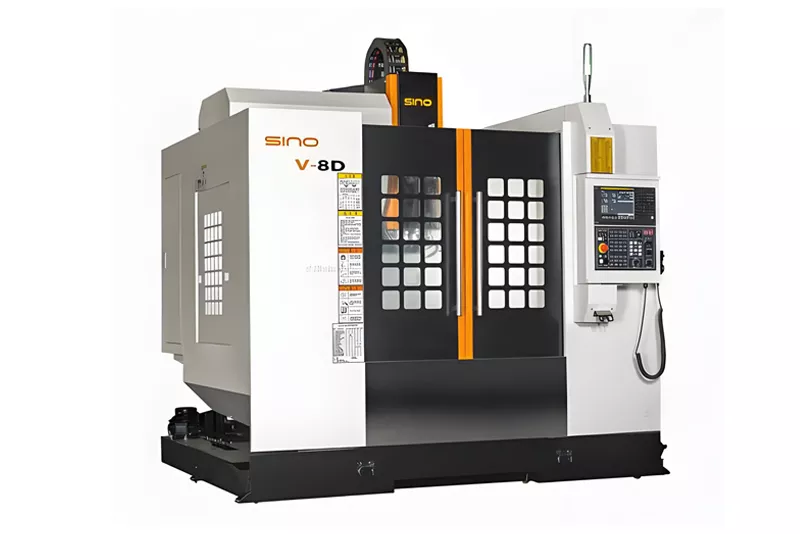
Computer numerical control (CNC) technology and equipment serve as enabling technologies and essential tools for the development of emerging high-tech industries and cutting-edge sectors. Modern CNC machine tools represent the epitome of mechatronics and serve as the foundational components for next-generation production technologies, such as Computer Integrated Manufacturing Systems. A machining center is a type of CNC machine tool equipped with a tool magazine capable of automa tic tool changing, enabling it to perform various machining operations within a specified range. Its key characteristics include: once a workpiece is clamped, the CNC system automatically selects and changes tools for different processes. The machine's spindle speed, feed rate, tool movement relative to the workpiece, and other auxiliary functions are automatically adjusted, allowing for continuous multi-process operations such as drilling, countersinking, reaming, boring, tapping, and milling on various surfaces of the workpiece. Machining centers integrate and automate multiple processes, minimizing human error, reducing time spent on workpiece clamping, measurement, machine adjustments, workpiece handling, and storage. This significantly enhances machining efficiency and precision, thereby delivering strong economic benefits. Based on the spatial orientation of the spindle, machining centers are broadly classified into vertical machining centers and horizontal machining centers.
CNC technology and equipment serve as enabling technologies and essential tools for the development of emerging high-tech industries and advanced industrial sectors. Modern CNC machine tools are typical products of mechatronics and form the foundation and a critical component of new-generation production technologies, such as computer-integrated manufacturing systems. A machining center is a type of CNC machine tool equipped with a tool magazine capable of automatic tool changes. It can perform multiple machining operations on a workpiece within a certain range. Its main features are as follows: after a workpiece is clamped once, the CNC system controls the machine tool to automatically select and change tools according to different processes. The machine's spindle speed, feed rate, tool movement path relative to the workpiece, and other auxiliary functions can all be automatically adjusted. This enables continuous multi-process operations, such as drilling, countersinking, reaming, boring, tapping, and milling, on various surfaces of the workpiece. Machining centers can integrate and automate multiple processes, reducing human operational errors, minimizing workpiece clamping, measurement, and machine adjustment time, as well as reducing workpiece handling, transportation, and storage time. This significantly improves machining efficiency and precision, thereby delivering excellent economic benefits. Based on the spatial orientation of the spindle, machining centers can be classified into two main categories: vertical machining centers and horizontal machining centers.
Currently, the manufacturing industry is undergoing transformation and upgrading, with an increasing demand for high-precision, high-efficiency, and intelligent processing. This trend is driving CNC technology to continuously push beyond traditional boundaries, which reflects not only enhanced technical capabilities but also a precise response to diverse customer needs. Beyond machining accuracy, technological innovation lies in the construction of intelligent production processes. By integrating advanced CNC systems, sensor technologies, and artificial intelligence algorithms, CNC machining achieves end-to-end intelligent control from design to production, significantly improving both production efficiency and product quality. At the same time, as downstream customer needs become increasingly diverse, customized production has emerged as a new industry trend. Machining enterprises must possess rapid response capabilities, leveraging modular design, flexible production lines, and other methods to achieve personalized product customization and meet the specific requirements of different industries and sectors. Additionally, the CNC machining industry makes significant contributions to sustainable green manufacturing technologies. In the face of environmental pressures and resource constraints, green technologies such as dry cutting, low-temperature cutting, and minimal or no cutting fluid machining are widely adopted, effectively reducing environmental pollution and resource consumption during the machining process.
Computer Numerical Control (CNC) technology has evolved alongside advancements in information technology, microelectronics, automation, and detection technologies, with its development trends focusing on high speed, high precision, multifunctional integration, and intelligence. The level of CNC technology is directly linked to a nation's overall strength, particularly in the realm of "high-precision and cutting-edge" CNC key technologies and equipment. Currently, countries worldwide are widely adopting CNC technology in industries such as information technology, biotechnology, automotive, and electronics to enhance manufacturing capabilities and levels, as well as to improve market adaptability and competitiveness. Its applications span numerous sectors, including automotive manufacturing, aerospace equipment manufacturing, shipbuilding, mold manufacturing, power generation equipment manufacturing, metallurgical equipment manufacturing, and communication equipment manufacturing. Therefore, vigorously developing advanced manufacturing technologies centered on CNC has become a crucial pathway for countries globally to accelerate economic growth, enhance comprehensive national power, and elevate their international standing.
China's 14th Five-Year Plan Outline points out that to promote the optimization and upgrading of manufacturing, we need to foster advanced manufacturing clusters, cultivate leading and pillar industries, and drive the integrated, clustered, and ecological development of strategic emerging industries, with the added value of strategic emerging industries accounting for more than 17% of GDP. Related advanced industrial equipment such as automobiles, integrated circuits, and robots (17.260, -0.12, -0.69%) all use CNC machine tools for precision production. As the types of China's advanced manufacturing industry continue to enrich, the demand for the CNC machine tool industry is constantly increasing. It is estimated that by 2029, the China CNC machining market size will exceed 600 billion yuan.
For a wide range of CNC machining fields, we primarily promote the following popular rental equipment: 1. α-D21MiA Drilling and Tapping Center As a compact machining center, the α-D21MiA is widely used for processing automotive components and mobile phone parts. Based on the principles of high speed, high precision, and high power, it delivers exceptional production performance and achieves high product qualification rates. The equipment is equipped with comprehensive preventive maintenance features, which help extend the machine tool’s service life and effectively prevent malfunctions. It offers excellent operability, high scalability, and easy integration and control of peripheral devices.
Key Technical Parameters:
• X/Y/Z axis travel: 500/400/330 mm • Tool magazine capacity: 21 tools • Worktable size: 650 mm × 400 mm • Worktable load capacity: 300 kg • Spindle speed: 100–24,000 rpm • Spindle taper: BT30
Second, the TC-510 drilling center series is designed and manufactured for customers pursuing high-volume production processing and efficiency. From machine structural analysis to actual cutting applications, it demonstrates appropriate cutting capabilities and output, meeting the needs of customers who pursue precision and efficiency. It has a small footprint, simple operation, and fast and efficient processing, especially for drilling and tapping processes. It is widely used in transportation, smart 3C, home appliance and other industries.
Core Parameters:
X/Y/Z axes travel:
510/420/350 mm Tool magazine capacity: 21 tools Spindle speed: Direct drive type, 10–24,000 rpm Worktable load capacity: 250 kg
III. S500X1 Compact Machining Center The S500X1 compact machining center features a comprehensive spindle product lineup, making it suitable for a wide range of industries, including automotive, semiconductors, precision components, and IT-related equipment. Equipped with a new-generation CNC system with faster processing speeds, it achieves high-speed and high-precision performance even in 3D machining applications. By optimizing control through its advanced system, the S500X1 minimizes inefficiencies in various machining movements, fully leveraging the high reliability of the machine tool to deliver superior production efficiency. It also enhances adaptability to cutting tools and fixtures, expanding the range of workpieces it can process. With a variety of specifications available, the S500X1 is designed to meet the demands of diverse and extensive machining fields.