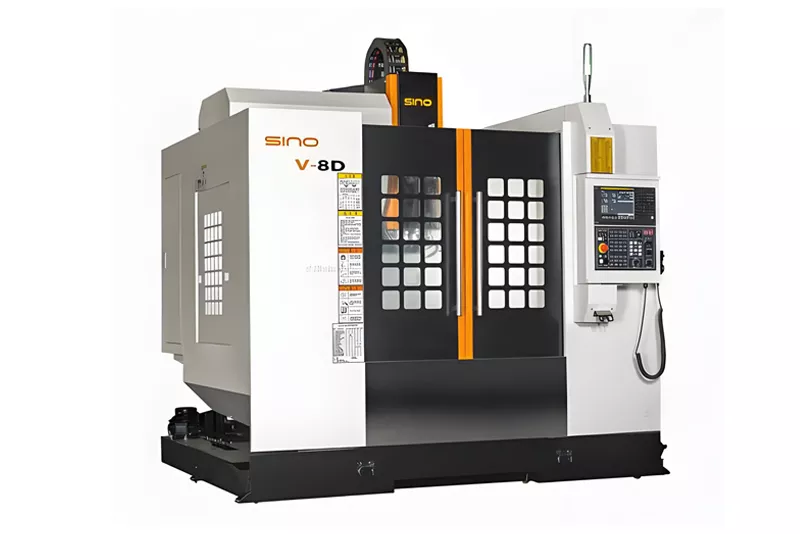
CNC machining centers are often hailed as the "all-rounders" of the machine tool industry, integrating multiple machining functions such as milling, boring, drilling, and tapping into a single unit. Equipped with tool magazines and automatic tool changers, they can perform various operations in a single setup, significantly enhancing production efficiency and machining accuracy while reducing workpiece handling times and errors.
From a structural perspective, machining centers can be categorized into vertical, horizontal, and gantry types. Vertical machining centers feature a compact design, occupy less floor space, and offer ease of operation, making them ideal for processing small to medium-sized parts. They are widely used in industries such as mold manufacturing and electronic equipment production. For example, in the machining of smartphone back cover molds, vertical machining centers can quickly switch tools and precisely mill intricate shapes and fine textures on the mold surface, ensuring high-quality aesthetics and dimensional accuracy of the phone covers. Horizontal machining centers, with their horizontally oriented spindles, provide greater rigidity and stability, making them suitable for machining large and complex parts such as engine blocks and housing components. They often incorporate rotary worktables that enable multi-face machining, minimizing the need for secondary setups and improving both accuracy and efficiency. Gantry machining centers are renowned for their massive structure and formidable machining capabilities. They are primarily used for processing large and heavy parts, such as aircraft beams and ship deck components. Their beam and ram structures deliver stable cutting forces, ensuring smooth operation and high precision throughout the machining process.
In the aerospace field, parts such as turbine wheels and blades of aircraft engines have complex shapes and extremely high precision requirements. CNC machining centers can control the machining accuracy of these parts at the micrometer level through precise programming and automated machining, ensuring the performance and reliability of the engine. In the automotive manufacturing industry, the machining of automobile engine blocks requires processing multiple hole systems, planes, and curved surfaces. CNC machining centers, with their advantage of multi-process integration, can efficiently and accurately complete the machining of engine blocks, improving the production efficiency and quality of automobiles.
Numerical Control Laser Processing Machine Tool: The Sculptor of Precision Light
CNC laser processing machines are equipment that utilizes high-energy-density laser beams to process materials. With unique advantages such as high precision, high speed, and non-contact processing, they demonstrate strong competitiveness across numerous fields. The principle of laser processing involves generating a high-energy laser beam through a laser generator, which is then transmitted through an optical path and focused by a lens onto the workpiece surface. This causes the material to instantly melt, vaporize, or sublimate, enabling operations such as cutting, welding, and drilling. CNC laser processing machines offer exceptionally high machining precision, reaching micron or even sub-micron levels, making them particularly suitable for processing small and intricate components. For instance, in the electronics industry, the miniature metal parts within smartphone camera modules demand extremely high dimensional accuracy and surface quality. CNC laser processing machines can achieve high-precision cutting and drilling through precise control of the laser beam, ensuring the reliable performance of the camera modules.
CNC laser processing machines are characterized by fast processing speed and high efficiency. For example, in laser cutting, they can achieve cutting speeds of several meters per minute or even higher for thin-sheet materials, significantly improving production efficiency. Moreover, laser processing is non-contact, meaning it does not subject workpieces to mechanical stress or cause deformation, making it particularly suitable for processing easily deformable materials such as thin-walled parts and brittle materials. In the automotive manufacturing industry, laser welding technology for car bodies has been widely adopted. By precisely welding various body components together using CNC laser processing machines, the strength and rigidity of the car body are enhanced, while the number of weld points is reduced, significantly improving the overall appearance of the vehicle.
In the field of medical device manufacturing, the precision and surface quality requirements for certain critical components, such as cardiac stents and dental implants, are extremely stringent. CNC laser processing machines, with their fine laser processing capabilities, can meet the high-precision manufacturing demands of these components, thereby ensuring the safety and efficacy of medical devices.