
How to choose between 5-axis machining centers and 3+2-axis machining centers?
In the high-end manufacturing sector, five-axis technology has become a powerful tool for machining complex parts. However, when faced with two mainstream technologies—true five-axis simultaneous motion and 3+2 axis positioning—many users feel uncertain during the selection process. In fact, there is no absolute superiority between these two solutions; the key lies in accurately matching them to your specific machining requirements. Next, the editor from Huaya CNC will help clarify these concepts and assist you in making the wisest investment decision.
I. Concept Analysis: What is 'True Five-Axis', and what is '3+2 Axis'?
First, we need to fundamentally understand the difference between the two.
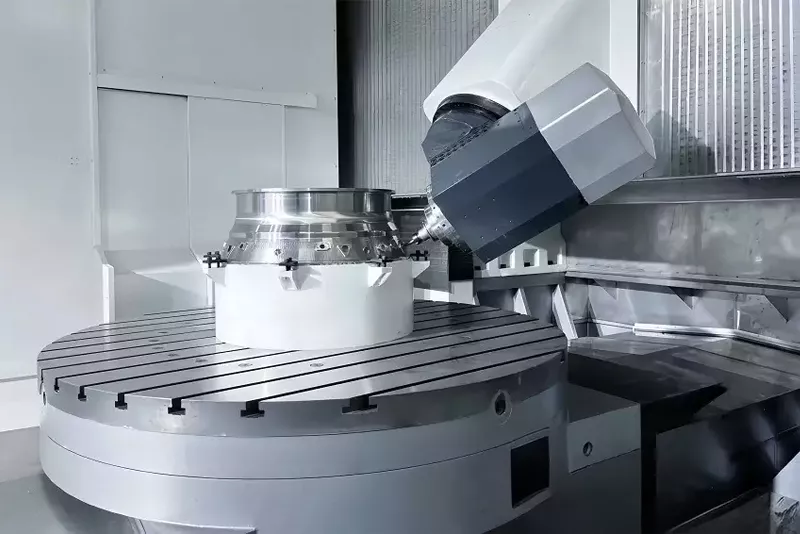
Five-axis simultaneous machining center: Refers to a machine tool in which the three linear axes (X, Y, Z) and two of the rotary axes (A, B, C) perform interpolation movements simultaneously. During machining, the orientation and position of the cutting tool change continuously in space, enabling the processing of complex free-form surfaces in three dimensions.
3+2 axis positioning machining: Essentially, this approach builds on three-axis machining by using rotary axes to tilt the workpiece and lock it at an optimal angular position, after which three-axis milling is performed at that fixed angle. The core concept is “positioning”—the rotary axes do not move in coordination (i.e., they are not linked/interpolated) during the cutting process.
In simple terms, five-axis linkage is 'dynamic machining', while 3+2 axes are 'three-axis machining at a static angle'.
II. Capability Comparison: How to Make a Choice Based on Core Needs?
Your product type and process requirements directly determine which solution is more suitable.
Select a five axis positioning machining if your requirement is:
Complex Spatial Surface MachininSpecial Trajectory Machining: When machining deep holes or angled holes with special angular requirements, or when the tool's side edge needs to be used for plunge milling processes, five-axis linkage is the only choice.g: This is the core application area of five-axis linkage technology. For parts with continuous complex surfaces such as turbine wheels, blades, integral engine casings in the aerospace field, and deep cavities, negative angles of high-precision molds, five-axis linkage technology must be used to achieve machining.
Pursuing ultimate surface quality: When machining curved surfaces, five-axis linkage can adjust the tool axis posture to allow the side edge of the ball-end mill to participate in cutting, avoiding areas where the centerline speed of the tool tip is zero, thereby achieving a more consistent and smoother surface quality.
Select 3+2 axis positioning machining if your requirement is:
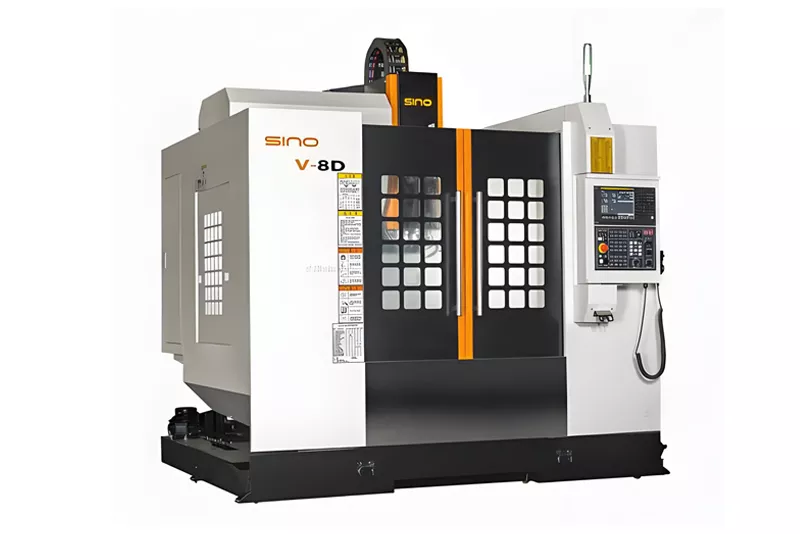
Multi-angle Feature Machining: For box-type and disk-collar parts, drilling, tapping, slot milling and other machining operations need to be performed on multiple surfaces. The 3+2 axis method can complete machining on five faces and multiple angles with a single setup, greatly improving efficiency and avoiding errors caused by multiple setups.
Reduce tool costs and improve rigidity: By tilting the workpiece, the tool can operate at the optimal cutting angle. Shorter, more rigid tools can be used for heavy-duty cutting with large depth of cut and high speed, which not only enhances processing efficiency and quality but also extends tool life.
Cost-effectiveness first: Typically, achieving 3+2 axis functionality costs less than a machine tool of the same class with full five-axis simultaneous capability. For companies that do not require continuous five-axis interpolation but still have angled machining needs, this is a highly cost-effective solution.