
High-speed milling is gradually becoming an important machining process for molds
The process of using EDM for precision machining and polishing of die surfaces has gradually decreased, while high-speed milling has gradually become an important machining technology for dies. It provides conditions for further shortening the production cycle of dies.
Molds are important basic process equipment with large and extensive usage in the machinery manufacturing industry, and have become an important means and process development direction in modern industrial production. The output value of molds in industrial developed countries such as the United States and Japan has long exceeded that of machine tools. Currently, the annual output value of molds worldwide is about 60 billion US dollars, exceeding the global output value of machine tools. In 1997, China's mold output value was already close to 20 billion yuan, but there is still a supply-demand gap for some molds, especially complex molds represented by automobile cover molds (the gap accounts for about two-thirds of the demand). The import amounts of molds from 1996 to 1998 were 918 million, 631 million, and 663 million US dollars respectively.
Faced with global market competition, as the new product development cycle and product update period continue to shorten, the demand for rapid response in mold design and manufacturing is increasingly higher. There is a need to shorten the mold production cycle as much as possible, which has become one of the important indicators to measure a country's manufacturing level.
With the advancement of mold CAD/CAE/CAM systems and the development of high-speed, precision, and numerical control machining equipment, further shortening of mold production cycles has become possible. This paper focuses on introducing the application of high-speed milling technology in mold manufacturing.
Since the 1980s, with the maturation and development of high-speed milling technology, the process of using EDM for precision machining and polishing of mold surfaces has gradually decreased, and high-speed milling has gradually become an important machining process for molds. In Germany and Japan, using high-speed milling as a means for semi-precision and precision machining of molds has become the mainstream process.
Reasons for adopting high-speed milling
1、In addition to cavities with internal acute angles and narrow and deep cavities, high-speed milling can basically replace EDM processing.
2、 Using high-speed milling to process molds can save 25% to 60% of processing time compared to the EDM method;
3、The surface quality of the mold is improved through high-speed milling, avoiding the occurrence of micro-fine cracks on the surface that may appear during EDM processing;
4、 High-speed milling of hard surfaces with a hardness of 45~60HRC can achieve a surface roughness of Ra=0.63μm after precision milling, thereby reducing the time spent on manual polishing, which is labor-intensive and costly.
5、It eliminates the manufacturing process of electrodes in EDM machining methods, thereby significantly shortening the cycle of mold manufacturing.
Tools used for high-speed milling of molds
Due to improvements in cutting tool material performance and the development of new tool materials and coating technologies, the allowable cutting speed of tools has almost doubled every 10 years. High-speed milling is precisely based on this important premise. Tool materials require high hardness, good wear resistance, good heat resistance (red hardness), as well as good toughness and impact resistance to meet the requirements of high-speed milling of high-hardness die steels.
1.Coarse milling and semi-precision milling typically use fine-grained or ultra-fine-grained carbide end mills with ball noses or flat ends, which are coated with composite coatings. The cutting depth is 0.1 to 0.3 mm, and the cutting speed can reach 150 to 250 m/min.
2. Use silicon nitride ceramic tools or Si3N4+TiC (or TiN) composite ceramic tools in semi-finishing and finishing milling, with a cutting depth of 0.05 to 0.15 mm, and the cutting speed can reach 250 to 600 m/min.
3. Ultra-hard material cubic boron nitride is the main tool material for high-speed precision milling of molds. Polycrystalline cubic boron nitride (PCBN) has high hardness and excellent heat resistance. In recent years, after improving toughness and achieving better chemical stability, it has begun to be used for high-speed milling of quenched steel molds. During precision milling, the cutting depth is 0.05~0.10mm, and the cutting speed is 300~1200m/min. The precision milling effect can almost replace grinding.
In addition to properly selecting cutting tool materials, high-speed milling should also optimize tool geometric parameters and address issues such as the dynamic balance of the tool (along with the spindle) and the vibration resistance of the tool holder. Compared with conventional milling, the rake angle of high-speed milling cutters is relatively reduced while the clearance angle is increased. When the milling cutter diameter is small (typically for ball-end mills), to avoid the performance degradation caused by the very low cutting speed at the top end of the ball near the rotational center, CNC machines that allow tool oscillation should be used, with the spindle usually tilted by 30°.
A CNC with one swiveling axis is a 4-axis CNC linkage, and one with two swiveling axes is a 5-axis CNC linkage. However, programming is more complex when using a flat-end milling cutter to mill 3D free-form surfaces.
"Integration Technology of CAD/CAM Systems and CNC Profiling"
In the CNC machining of complex mold surfaces, it is necessary to first generate tool paths and CNC machining instructions, which can be achieved through CNC contouring measurement. That is, based on the CNC contouring measurement results (3D point cloud data) of the physical (sample) model, a digital geometric model of the shape is established. Then, the CAD/CAM system generates the tool paths and CNC machining instructions (see Figure 1), thereby allowing the CNC machine tool to machine a surface shape that is consistent with the physical model.
Thus, direct measurement of the complex curved surfaces of the mold is introduced into the design-manufacturing process, forming an integrated measurement-modeling-manufacturing system, namely a CNC contour milling machine.
It is completely different from traditional mechanical or electrical profiling milling machines. It not only has CNC and profiling functions but also has digital functions.
This CNC contour milling machine is particularly suitable for contour machining of complex mold surfaces with shallow cavities, small variations in surface height, and considerable slope in the surface contour. Its digital touch probe or non-contact laser probe (laser scanning sensor) can perform contour scanning and digital conversion at a speed of up to 10 m/min or even higher, with a contour accuracy of ±5μm.
Conditions that high-speed milling machine tools must possess
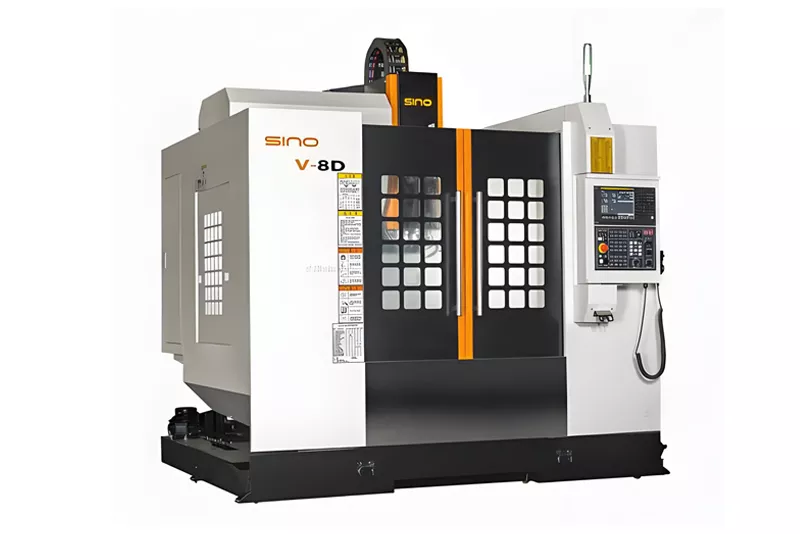
CNC profiling milling machines, CNC high-speed milling machines, or high-speed machining centers are the machine tools used for high-speed milling of molds, and these machine tools have the following basic characteristics:
High-speed, high-power spindle unit. It can provide a very high rotational speed because ball-end end mills often have a small diameter; to achieve a sufficiently high cutting speed, the spindle must have an extremely high rotational speed. As shown in Figure 2, the HSM700 high-speed milling machine (processing center) developed by Swiss MIKRON Company has a maximum spindle speed of 42,000 r/min.
A high-speed feed system with high acceleration and deceleration. High-speed milling not only has a high cutting speed, but also requires a correspondingly high feed speed to maintain a reasonable feed per tooth. The working feed speed of the HSM700 high-speed milling machine can reach 20 m/min, the acceleration of the feed axis is 10 m/s², and the maximum rapid traverse speed is 40 m/min.
The spindle end structure of a 1:10 hollow short taper tool holder with dual positioning using a conical surface and end face, as well as the HSK tool system, ensures the centering accuracy of the tool at extremely high speeds.
High-speed precision CNC system. It features high-precision servo units that can reduce tracking errors during contour machining, optimal acceleration and deceleration characteristics, as well as various error compensation and predictive control functions.
It can not only achieve dry cutting, but cutting fluid can be used when necessary, or air-oil jet cooling (with minimal oil quantity) can be used.
There is a fully enclosed safety protection device.
The entire machine has good thermal stability and dynamic rigidity.
In recent years, the parallel linkage machine tool (also known as a virtual axis machine or colloquially referred to as a six-legged machine) has gained popularity. Its motion is based on the Stewart platform principle, making it particularly suitable for high-speed machining and offering a wide range of processing capabilities.